Tooling · model pace
Google makes the fast lane the default lane.
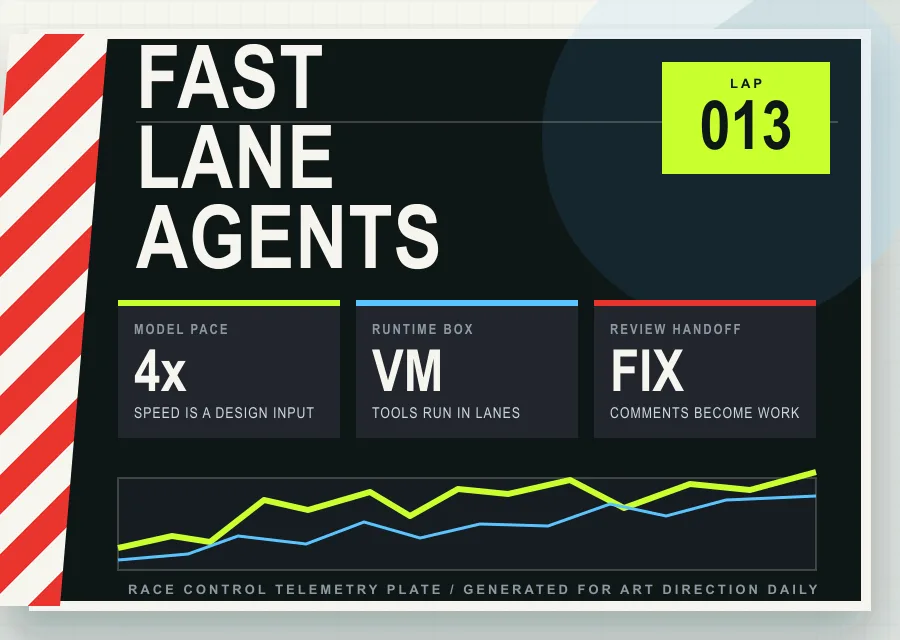
Google introduced Gemini 3.5 Flash on Tuesday as a model built for agentic workflows, coding, and long-horizon tasks. The headline claim is not just higher intelligence. It is that a Flash-tier model can now carry serious tool use while staying fast enough for iterative work.
For web teams, that changes the design pressure around AI-assisted building. If an agent can produce four checkout-flow directions in a minute, the bottleneck moves from generation to selection: which route is coherent, brand-safe, accessible, and worth hardening into production?
Speed turns review into interface work
Google's examples lean heavily on parallel subagents and richer web UI generation. The practical lesson is narrower and more useful: when a model can try several approaches quickly, the product surface needs a pit wall. Designers and developers need comparison views, checkpoints, and clean reject buttons as much as they need another faster prompt box.
Technique · gateway routing
The model picker becomes part of the control system.
Vercel added Gemini 3.5 Flash to AI Gateway on the same day, positioning it for coding proficiency, parallel agent loops, and multi-turn coherence. The bigger signal is the gateway layer itself: teams increasingly want one place to route models, track usage, set fallbacks, and observe performance.
That is a quiet but important shift for builders. The agent stack is becoming configurable infrastructure, not a single magic model hidden behind a button. A studio can choose the fast model for exploration, reserve a heavier model for final review, and keep usage visible enough to understand why a workflow changed cost or quality.
Latency is a material
Designers already think in terms of friction, delay, and feedback loops. Model latency now belongs in that same vocabulary. A fast model can make a design tool feel conversational; a slow one can still be right for deep evaluation. The interface should tell the user which mode they are in instead of pretending every agent run has the same cost.
Workflow · runtime safety
The fastest agent still needs a safe garage.
Vercel also announced that teams can run Claude Managed Agents with Vercel Sandbox. Anthropic handles the model loop and session state; Vercel supplies the execution room, with each agent session isolated in a Firecracker microVM and network rules that can keep tool calls on a short leash.
This matters because website work touches private APIs, customer data, deployment credentials, and internal services. A useful agent is one that can reach the real system. A trusted agent is one whose reach is constrained, logged, and understandable after the fact.
Design the stop points first
The pit-wall metaphor is useful here because the crew does not wait for the car to fail before deciding what signals matter. They define the telemetry, thresholds, and radio calls before the lap starts. Agentic workflows deserve the same preparation: domains it may touch, credentials it may never see, actions that require confirmation, and logs a human can replay.
Prompt Lab · race plan
Prompt Lab: recreate this page.
Paste this into your AI design or build tool to reproduce this issue's visual system.
Design a single self-contained HTML page as a race-control pit wall, motorsport telemetry as an operations surface. The content is a daily design-news briefing: a top nav, an issue masthead with number, date, and read time, a hero headline with a one-line deck, a boxed art-direction note, numbered sections of linked news items with one or two sentences of context each, one pullquote, a monospace prompt block, a sources list, and a colophon.

Treatment: cool gray paper #E9ECE7 with carbon panels #111417 and #2A3238; the hero as a pit-wall control board; sections as sector reports with curb-stripe edge marks; takeaways styled as radio calls; lap-board tiles for metadata; telemetry lime #C9FF2E reserved for timing data, traces, and live marks, never prose; thin timing rules between rows.

Type: Bebas Neue for condensed display, IBM Plex Sans for body, Fraunces italic for one editorial aside, IBM Plex Mono for timing labels and sector numbers.

Guardrails: body text at least 18px with line height 1.6 or more, prose in the body face and never in monospace, line length 60-75 characters, WCAG AA contrast on every surface, hover and focus states on real links, decoration in the margins and panels rather than under running prose, no fake readable text in images, and no default AI styling (no purple-blue gradients, no glow, no pill-shaped everything). Lime on carbon only, never lime on light gray.
Works in v0, Lovable, Bolt, Figma Make, Beaver Builder AI, or as a Claude / GPT system brief.
Field note · synthesis
Field note: agent speed is now a design problem.
Digg's AI board captured the Gemini launch as the loudest cluster of the day, but the useful story is not model hype. It is the convergence around control surfaces: model gateways, sandboxed runtimes, review dialogs, reusable skills, and agent apps built around steering rather than awe.
The next useful web-building interface will not just ask what you want to make. It will show which lane the agent is in, what it is allowed to touch, what evidence it is collecting, and where a human gets the radio call.
Sources · verified 20 May 2026
Sources.
- P01Digg AI top storiesDigg · live board checked 20 May 2026
- P02Gemini 3.5: frontier intelligence with actionGoogle · 19 May 2026
- P03Gemini 3.5 Flash on AI GatewayVercel Changelog · 19 May 2026
- P04Run Claude Managed Agents with Vercel SandboxVercel Changelog · 18 May 2026
- P05Easily apply Copilot code review feedback with Copilot cloud agentGitHub Changelog · 19 May 2026
- P06One-click fixes for failing Actions with Copilot cloud agentGitHub Changelog · 18 May 2026
- P07GitHub Copilot app is now available in technical previewGitHub Changelog · 14 May 2026
- P08Figma product news and release notesFigma · May 2026