Today's art direction
Pricing & Packaging Page / Tiered Plan Comparison
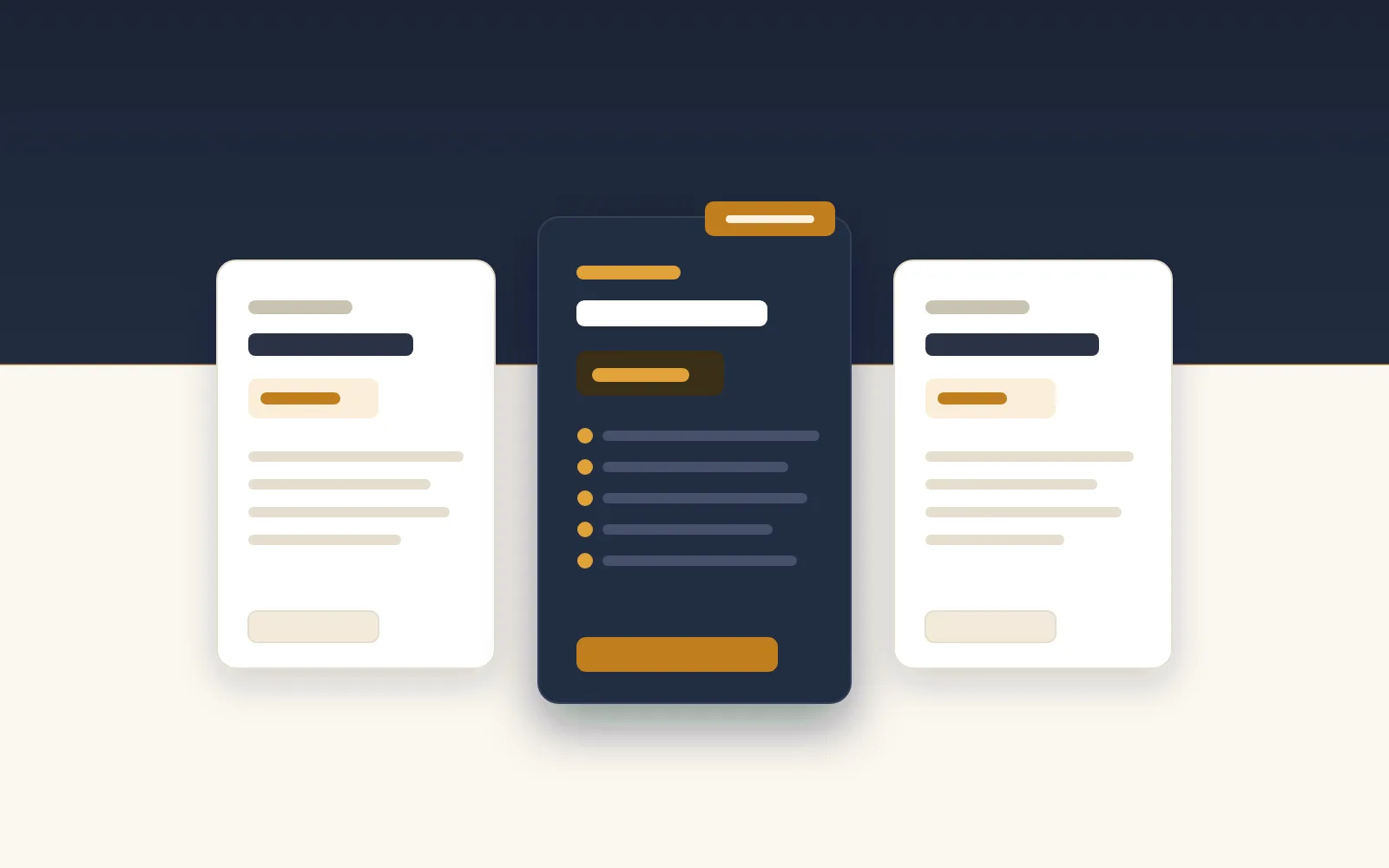
A SaaS pricing page: a dark plan band, three tier columns bridging into ivory, one plan recommended.
Today's page is built like the pricing page every SaaS site eventually ships: a dark plan band up top, three tier columns that overlap the seam into the lighter section below, and one tier marked as the popular pick. The news items are the plans, each with a price chip standing in for its hook. The reusable move is the layout itself, recommended tier set apart by weight and surface rather than a colored side stripe, and a comparison matrix that tells the truth about the trade between columns.
Tooling
Small enough to run where the page is
Quantization-aware training simulates the rounding errors of compression while the model is still learning, so the smaller version loses far less quality than squeezing a finished model would. The practical result Google reports is a Gemma 4 E2B that fits in roughly a gigabyte, with checkpoints packaged for llama.cpp, Ollama, and LM Studio.
For people building interfaces, the line that matters is the one a model crosses when it can live next to the work instead of behind an API. A design or build assistant that runs on the machine changes the latency, the privacy story, and the offline behavior of whatever you ship around it. Coverage of the release puts the edge models well inside laptop and phone budgets.
Technique
Read the plan before you pick it
Three announcements this week describe the same shift from different desks: where the cost of an AI build lands, and on whom. Laid side by side they read like a comparison matrix, which is the honest way to choose a plan.
| Local | Metered | Accountable | |
|---|---|---|---|
| What changed | Model runs on-device in ~1 GB | Agent usage billed separately | Terms name AI-taken actions |
| Who pays | Your hardware | A monthly credit | You, by signing |
| In effect | Jun 5 | Jun 15 | Jun 4 |
| The trade | Smaller model, your RAM | Predictable, but capped | You own the agent's moves |
The middle column is the one builders are arguing about, because a flat subscription quietly subsidized a lot of background agents. Once that usage gets its own meter, the cost of letting an agent run unattended becomes a number you can see.
Workflow
Scope the agent like a paid seat
Vercel's new language about actions taken on your account by AI is a quiet signal worth acting on before the bill or the audit does. Treat an agent that touches your project as a real account with real reach, and give it the smallest plan that still works.
- Give each agent its own scoped credential, not your personal token, so its actions are attributable and revocable.
- Prefer short-lived, single-purpose access over standing keys, the way a signed upload URL expires instead of granting the whole store.
- Keep a reviewable trail of what the agent did, and decide which moves it may take unattended versus which wait for a human.
“The cheapest plan is the one where you can still see what you are paying for.”
Field desk, Art Direction Daily
Prompt Lab
Recreate this page
Paste this into your AI design or build tool to reproduce today's visual system.
Design a single self-contained HTML page styled as a SaaS pricing and
packaging page, the kind a product site ships to compare plans.

PAGE ARCHETYPE: a tiered pricing page. Above the fold, a dark slate plan
band holds the top nav, a small masthead line, a large headline, a short
deck, and an abstract plan-stack image on the right. Three pricing-tier
columns sit centered and overlap the seam where the dark band meets the
lighter page below.

COMPONENTS: three tier cards, the middle one "recommended" and set apart
by a darker surface, heavier type, and a small ribbon, never a colored
left stripe. Each card has a small-caps plan label, a tier name, a
monospace price chip, one short sentence, and a text link styled as the
plan's call to action. Below, build the article sections with a
comparison matrix table (real text cells, not check marks), numbered
workflow steps, one pullquote, and a numbered sources list.

PALETTE: ivory paper #FBF8F1, deep slate band #1B2435, amber accent
#C07E1E for prices, ribbon, and marks, slate #5A6377 for secondary text,
hairline #E4DECF. No purple-blue gradient, no neon, no glow.

TYPE: Fraunces for the headline, tier names, and section headings;
Instrument Sans for body prose; Spline Sans Mono for price chips, labels,
and metadata.

GUARDRAILS: body text at least 18px with 1.6 line height and WCAG AA
contrast. Never set long prose on the dark band. Cap card radius around
14px and chips around 7px; vary radius with purpose. Give cards and links
honest hover and focus states with ~160ms easing, and disable transforms
under prefers-reduced-motion. No fake toggles or dead search fields, and
no readable text inside the generated image.
Field Note
The bottom line
Sources
Linked this issue
- Gemma 4 QAT models: optimizing compression for mobile and laptop efficiencyblog.google
- Google DeepMind releases Gemma 4 QAT checkpoints that cut on-device memorymarktechpost.com
- Anthropic ends subscription subsidy for agents June 15; credit pool replaces flat-rate accesstechtimes.com
- Updates to legal termsvercel.com
- AI didn't break the web. The dotcons didhamishcampbell.com
- Hacker News discussion of the Gemma 4 QAT releasenews.ycombinator.com
A field experiment from the team behind Beaver Builder AI.