The Collection
Art Direction Daily / agentic web design, daily
New this week · Summer 2026
Claude Code can now publish the page it just built
A coding session ships itself as a live, shared page. Claude Design round-trips through your real components and out to code. And a new browser standard lets a page hand agents a menu of typed tools. The web surface you finish is becoming something the next agent can read and run.
Mid-Century Modern Lifestyle Brand
The day's briefing dressed as a warm homeware catalog: color-zoned departments, atomic-era marks, and flat Girard color on cream.
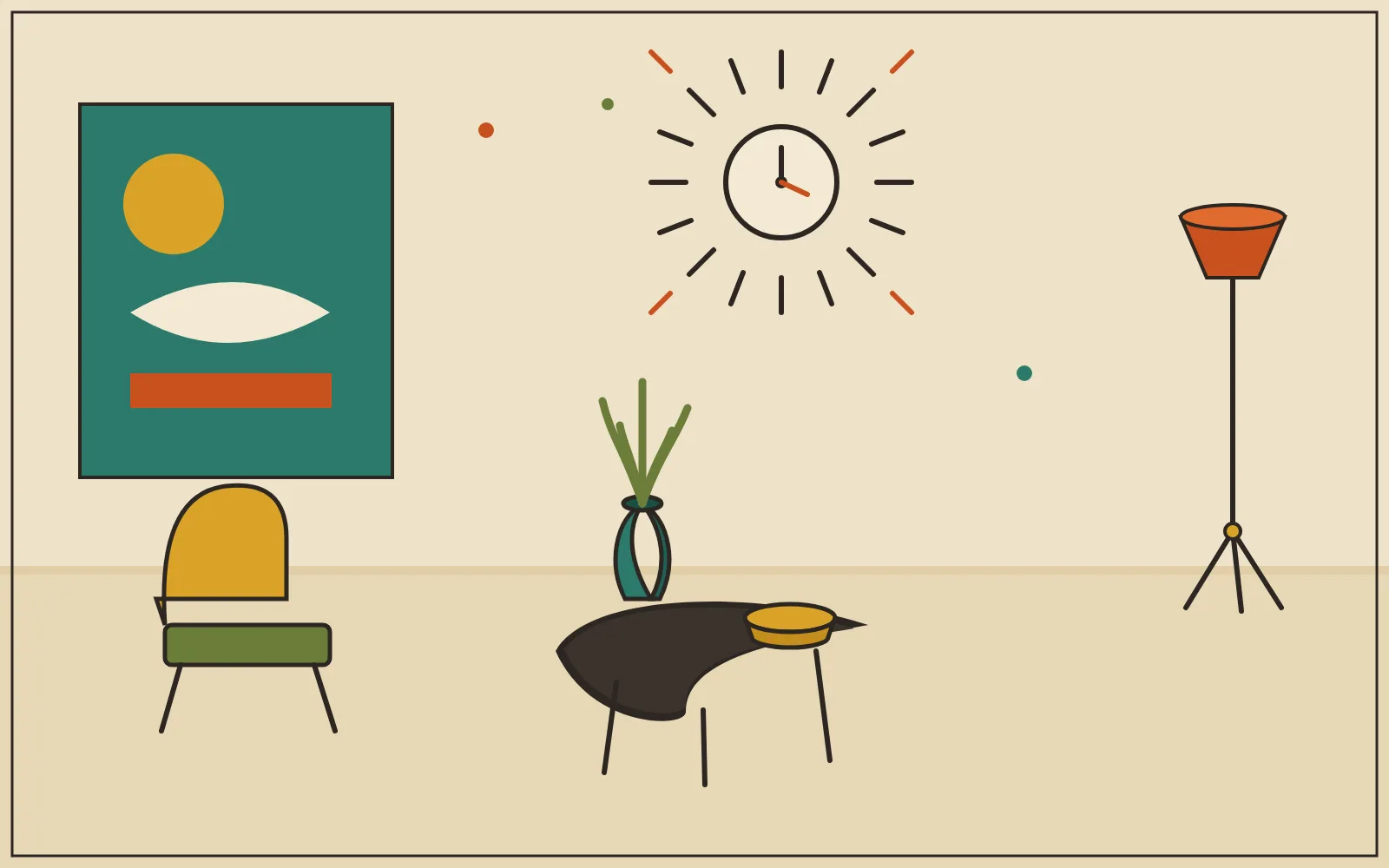
Mid-century lifestyle brands sold a feeling through warm flat color, friendly geometry, and a few atomic motifs. Translated to the web it becomes a lookbook: a campaign hero over a single still-life plate, then a product grid color-zoned by department rather than the usual three identical cards. Each story is a product, marked by a starburst, a boomerang, or a circle in its zone color, with copy as the caption and the source named like a maker.
Studio Tools
Dept. 01Claude Code publishes a session as a live page
Anthropic added Artifacts to Claude Code: a session can publish part of its work to a private URL on claude.ai and keep updating it in place as the work continues. The documentation is plain about the limit, calling an artifact a capture of work and not an application, one self-contained page with no backend, which fits a pull-request walkthrough with annotated diffs, a dashboard built from session data, or an investigation timeline that fills in as Claude works.
It needs a Team or Enterprise plan and a signed-in session, and it reached the top of Product Hunt the day after the rollout, where VentureBeat framed it as turning the terminal into a shareable canvas.
code.claude.comMethod
Dept. 02Claude Design builds from your components, then hands the file to code
Two months after its preview, Claude Design got a rebuilt design-system import: point it at a GitHub repository, design files, or raw uploads, and it builds with those components and checks its output against the system before you see it. A new design-sync command pulls a codebase's system into the tool, and a finished prototype hands off to Claude Code to implement with no screenshot and no rebuild in between. The work also exports out to Canva, Lovable, Replit, Vercel, and Wix, which positions Claude Design as where a design starts rather than where it ends.
engadget.comProcess
Dept. 03A webpage can hand agents a menu instead of a screenshot
WebMCP is a proposed browser standard that lets a page declare its own features as typed, named tools, so an in-browser agent calls a function like checkout or filter results rather than scraping the DOM or guessing where to click. The Web Machine Learning Community Group published a fresh draft this week, and the experimental origin trial is live in Chrome 149 with Microsoft co-developing the spec. For a builder it reframes a finished page as a small, well-labeled toolkit that keeps your real interface and brand in front of the agent.
webmachinelearning.github.ioThe page a designer ships is becoming the interface the next agent reads, and the one it acts through.
Prompt Lab
Recreate today's catalogDesign a single web page as a mid-century-modern lifestyle brand's product catalog presenting a short briefing of linked stories. Page archetype: an ecommerce category or lookbook page, not a dashboard, blog, or card-grid template. Ground: warm cream (#F4E9D4) with a lighter card paper (#FBF4E6). Body ink is warm near-black (#2B2622). Use a warm multi-hue mid-century palette in the Alexander Girard register: burnt orange (#C8501E, links and brand marks), teal (#2C7A6B), marigold (#D9A328), and avocado (#6B7D3A). Links in a darker rust (#A8410F) so small text stays WCAG AA on cream. Layout: a catalog masthead with a brand wordmark and a row of issue metadata cells; a campaign hero with one large headline and a deck; then one full-width flat still-life plate; then a product grid color-zoned by department. Do not use three identical feature cards. Color-zone the structure instead: each department (Tooling, Technique, Workflow) is a panel tinted in its hue with a solid filled department band on top, carrying a small atomic motif mark (starburst, boomerang, or concentric circle) in the zone color, a slab-or-sans department name in spaced caps, and a department number. Each story is a product card: a mono kicker, a product-name headline that links out, one or two plain caption sentences, and the source domain named like a maker. Type: a warm humanist or geometric sans for display and product names (Familjen Grotesk), a friendly sans for body (Figtree) at 19px with line-height 1.7 and a measure near 66 characters, and a mono (DM Mono) only for tiny labels, metadata, and swatch hex codes. Exactly one italic display pullquote. Include one generated plate: a flat, mid-century still life (a starburst clock, a tripod sputnik lamp, a boomerang table with a ceramic vase and a spiky plant, a low lounge chair) in flat color fields with a clean keyline and no readable text inside the image. Add one restrained micro-interaction, an underline that shifts to orange on link hover, behind a prefers-reduced-motion guard. Keep WCAG AA on every text color against its real background. No gradients, no glow, no neon, no pill-shaping everything, no accent left-border stripes, no fake search fields or toggles, no emoji.
Works in: Beaver Builder AI, v0, Lovable, Cursor, Figma Make.
Three releases pointing the same way: a session that publishes itself, a design that round-trips to code, and a page that declares what an agent may do with it. The thing a designer ships is turning into a surface other software reads, edits, and operates.
Sources
- Share session output as artifactscode.claude.com
- Claude Code Artifacts bring live, shared dashboards to enterprisesventurebeat.com
- Anthropic's design assistant now works better with its coding agentengadget.com
- Anthropic ships a major Claude Design overhaulventurebeat.com
- WebMCP draft, Web Machine Learning Community Groupwebmachinelearning.github.io
- WebMCP on Chrome for Developersdeveloper.chrome.com