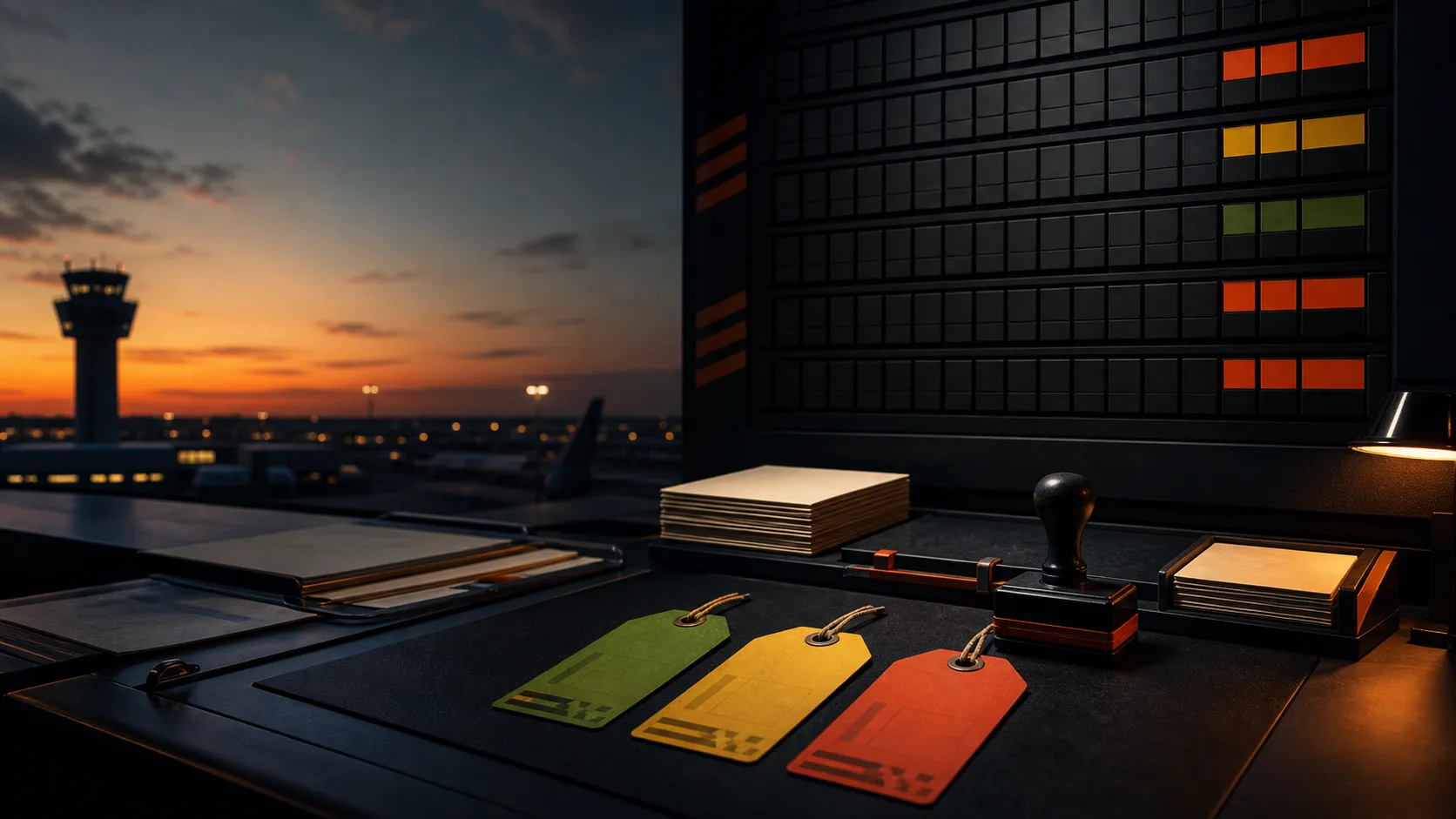
Generated night operations image: blank split-flap tiles, review tags, paper cards, and a control-desk stamp.
IssueNo. 060
DateMonday, 6 July
DeskReview control
Read≈ 5 min
Lovable's 150-PR week enters the night desk
AI code reviewneeds aflight desk
Lovable's token-spend report turns scale into an interface problem: when software work moves through many agents, the product surface needs clear lanes for risk, review, and escalation.
Fast AI reviewSlow AI reviewHuman hold
Today's Art Direction
A dark airport night-operations desk for sending AI-coded work through risk lanes instead of a single review queue.
The page borrows from split-flap boards, flight strips, control desks, review tags, and release stamps. Its borrowable move is a risk runway: classify work before review, show which lane owns it, and make human escalation a visible gate instead of a vague promise.
Night deskRisk runwayGate laneEscalation deskStatus tileControl stripHuman holdRelease stamp
Alexander Lebedev's July 3 post says his Lovable workflow moved from a few agents and 20 to 30 merged PRs in a productive week to six or seven agents, subagents, and 150 plus merged PRs.
The useful detail is the review surface. The post describes AI classification for PR risk, with fast AI review, slower AI review, and human review for high-risk changes.
Primary source: Lovable, 3 July. HN item 48789042 surfaced it on 4 July.
Phi Browser 2.0 shipped July 2 with Spaces, Profiles, URL Rules, a smarter assistant, and a local AI guardrail. The release says Spaces organize work for humans and agents, while Profiles keep sessions and cookies separate.
For agentic web design, that is the same runway problem in browser form. The interface has to show which container owns a task before the assistant acts across it.
Keyhole appeared on Hacker News today as a localhost handoff for secrets. The page frames the tool around a reference, not the secret value, so the agent receives a retrieval path instead of raw credentials in context.
That should influence builder interfaces. Credentials, tokens, and client access need a visible handoff state, not a textarea where sensitive material disappears into a transcript.
Query Companion surfaced today as a natural-language PostgreSQL tool that shows generated SQL before execution and enforces read-only transactions at the AST level.
The web-specific lesson is not the database. It is the state display: generated action, safety boundary, and result all appear in order, so a user can inspect the lane before trusting the answer.
Nectar's Show HN page pitches a Rust-like component language that compiles to WebAssembly with a tiny JavaScript syscall layer and no node_modules dependency chain.
Whether or not that model wins, the product page is a useful contrast to sprawling agent stacks. A generated site builder should be able to show the route it chose, the runtime it depends on, and the cost of leaving that route.
Feyn's June 25 field note introduced Pulpie, an open-source model family for extracting main content from HTML. It is older than the first news window but still within two weeks and reached Hacker News today.
Designers working with retrieval-heavy AI features should notice the premise: context quality depends on extraction choices. Interfaces need a place to show what was cleaned, what was dropped, and where the source route came from.
Use a risk runway when AI work can move through several review modes. Classify the work first, then show the lane, owner, evidence, and stop condition prior to acceptance.
Where it works
AI code review, CMS changes, design-system migrations, database assistants, browser agents, and client handoffs all need a visible route from generated work to trusted release.
Keep it honest
Do not decorate a normal queue with travel labels. The lane has to change behavior: faster machine check, slower second pass, or human hold with clear evidence.
Prompt Lab
Works in Beaver Builder AI, v0, Lovable, Framer, Figma Make
Create a responsive editorial web page using an Airport Night Operations Desk archetype for an AI web design briefing about agentic coding scale and review risk. Build the first viewport as a dark terminal control desk: a full-bleed generated operations-desk image sits behind the layout, the headline appears as oversized split-flap tile strips, and review-lane strips sit at the bottom of the hero. Use deep airport ink (#07101B), warm ticket paper (#F2E7D4), safety orange (#D85C2A), gate green (#5F7F52), muted sky blue (#6A94A8), and amber status light (#D6A23F). Pair Bebas Neue for display, Literata for readable body text and italic notes, and IBM Plex Mono for gate labels. Mark story sections as departure board rows with gate labels, linked primary-source headlines, verified dates, and one or two plain paragraphs. Include a Design Move section that teaches the risk runway pattern: classify AI work first, show the lane, owner, evidence, and stop condition prior to acceptance. Keep body text at 19px or larger with line-height above 1.6, use real hover and focus states, avoid fake controls, avoid neon or glow defaults, and keep all image text abstract or blank so it never relies on generated copy.
Field note
Scale does not remove review. It changes the terminal. The better AI-builder surface shows which runway the work is on before anyone waves it through.