Art Direction Daily presents · No. 063 · one night in production
Vercel gives its agent a badge
Agent identity, scoped permissions, and a paper trail: the platform news this week reads like a stage door learning to check laminates. Tonight's page is the run sheet.
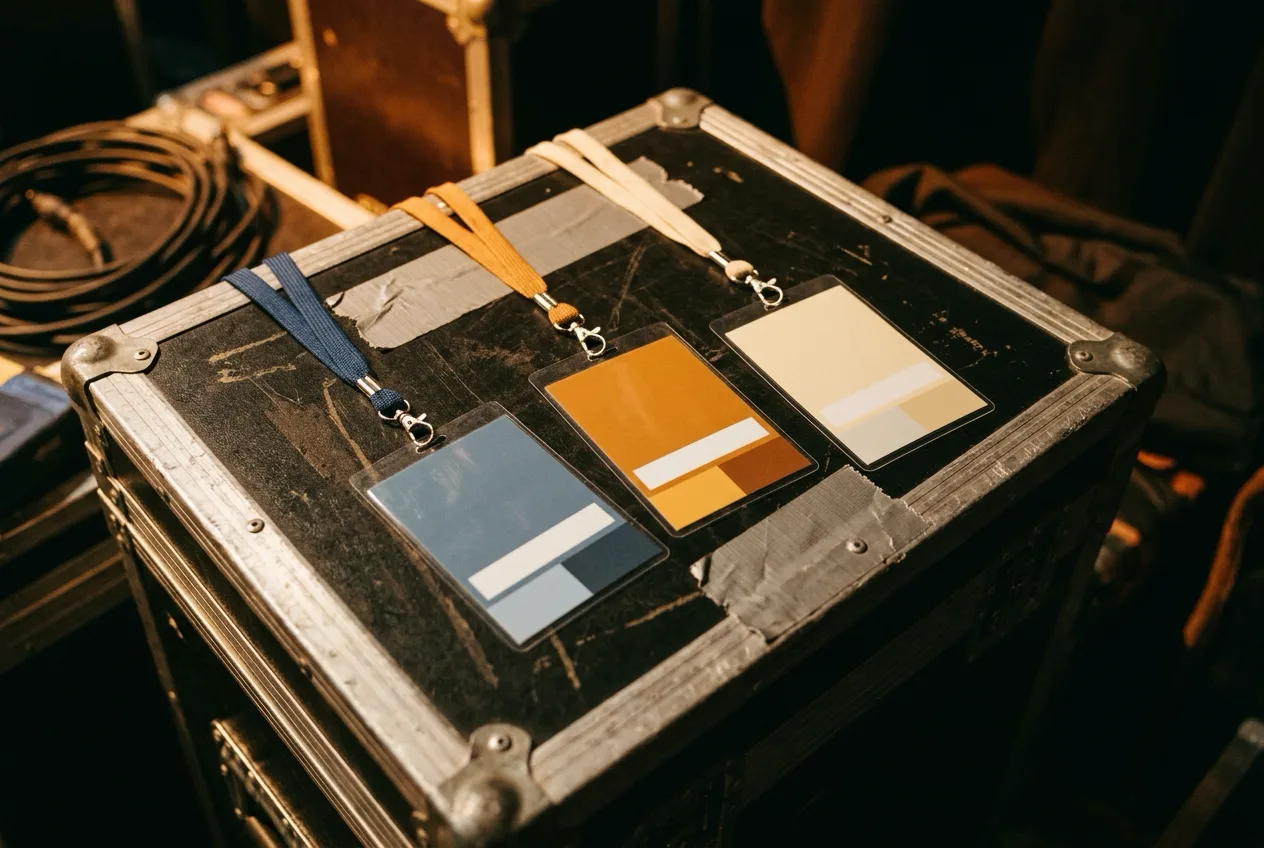
Plate 063: three laminates on the road case, scopes blank until showtime. Generated.
No. 063Thursday, 9 July 2026≈ 4 min readDoors 19:00
Today's Art Direction: Show-Day Run Sheet
A gig page for the one night the agent plays production, laminates checked at the door.
The page borrows the paper world of a working venue: poster type in an expanded ultra-black face, a run-of-show timeline with mono time chips, a perforated ticket stub for the masthead, and laminate credential cards on lanyards. Warm black stands in for the house before doors, with tungsten amber as the single loud accent and follow-spot blue and gaff rust kept for the passes. Every story is a stop on the run sheet, because that is how a crew actually ships a show.
Run sheetLaminateLanyardStage doorTicket stubTungsten poolGaff tapeSetlist
Vercel Agent moved into the dashboard this week wearing a security model built like a stage door. The agent carries its own identity, requests scoped permissions for each task, and runs generated code only inside disposable Firecracker sandboxes. It investigates incidents, reviews pull requests, diagnoses failed builds, and proposes fixes, and Vercel says it never changes production on its own.
The pattern worth studying is the plan-to-permission loop: the agent proposes a plan, gets capabilities scoped to that plan, and drops back to read-only when the work ends. Every change records who asked for it, who approved it, and that the agent carried it out. Rollout is gradual for Pro and Enterprise teams.
Agent · Investigate
Read logs and traces
Query production metrics
File the incident report
Cannot touch a deploy
Agent · Review
Read the pull request
Flag risky changes
Comment with evidence
Cannot merge anything
Agent · Fix
Build in a sandbox
Run the test suite
Propose the patch
Ships only with approval
The security model as a lanyard rack: three scopes, each stamped with the one thing it cannot do.
The badge has infrastructure behind it. Better Auth said it was joining Vercel on Tuesday; Vercel's side of the announcement names the reason as agent identity. The team's Agent Auth Protocol gives every agent its own credentials with scoped, revocable permissions, and the MIT licensed library keeps its name, governance, and four million weekly downloads.
The crew rolled a new backline onto the stage: TypeScript 7.0 is the native port, with builds roughly ten times faster on large codebases and editor errors in VS Code dropping from 17.5 seconds to under 1.3. Strict mode is now the default. Frameworks that lean on the old programmatic API, including Vue and Svelte, stay on 6.x until a stable one lands.
Tonight's launch act: the YC backed Context.dev turns any public website into structured data by schema, markdown, or screenshot. The endpoint designers should notice extracts a site's brand: logos, colors, fonts, and a working styleguide, over an API. The free tier is 500 credits with a work email, and agents can even sign themselves up.
Infisical wrote up a support agent built on Vercel's eve framework whose environment contains only placeholder strings. Real credentials live in an open source proxy called Agent Vault and get injected after requests leave the agent's process, so a prompt injection like the one that drained private repos in yesterday's issue would find nothing to steal.
Borrow this pattern
The scope-honest laminate
Present tiers of anything, pricing plans, membership levels, client roles, API scopes, as credential cards: a colored header band, a punched lanyard hole, a short mono list of what the tier can do, and one stamped line stating what it cannot. Use it on pricing pages, member portals, and settings screens where access differs by level.
What keeps it honest: the exclusion line is real content, written as plainly as the features. If you cannot say what a tier will never do, the tiers are decoration, and readers can tell.
Prompt Lab
Works in Beaver Builder AI, v0, Lovable, Framer, Figma Make
Recreate today's show-day run sheet as a working event page.
Create a one-page show-day event page for a music venue, styled as a backstage run sheet under tungsten light. Structure: a full-width poster hero on a warm black ground with a small mono stage-door kicker, a giant expanded ultra-black uppercase headline, a one-line support-act deck, a wide photographic art band of blank backstage laminates on a road case, and a perforated ticket-stub meta strip with punched notches at each end; then a vertical run-of-show timeline where a thin rail connects mono time chips labeled DOORS, SUPPORT SET, CHANGEOVER, HEADLINE SET, and ENCORE, each stop holding one act with a heading and two sentences; inside the first stop, a row of three laminate credential cards, each with a colored header band, a punched hole, a short mono list of what the pass allows, and one dashed-rule line stating what it cannot do; close with a cream production memo taped at the corners, a setlist-style numbered link list, and a stage-crew colophon. Palette: warm black #161210, warm cream #F4EADA, tungsten amber #E8A33C as the only loud accent, follow-spot steel blue #7C93A8 and gaff rust #A0472B reserved for the laminates. Type: Anybody Expanded Black for display, Schibsted Grotesk for body, Martian Mono for times, scopes, and labels. Keep body text at 19px or larger with line height at least 1.65, cream on warm black at WCAG AA contrast, laminate corners at 10px and everything else nearly square, real hover and focus states with easing near 150ms, no glow shadows, no neon, no gradient text, and no readable text inside the photograph.
Field Note
Every venue solved delegation the same way: nobody argues with the person, they check the laminate. The web is finally printing laminates for its agents.