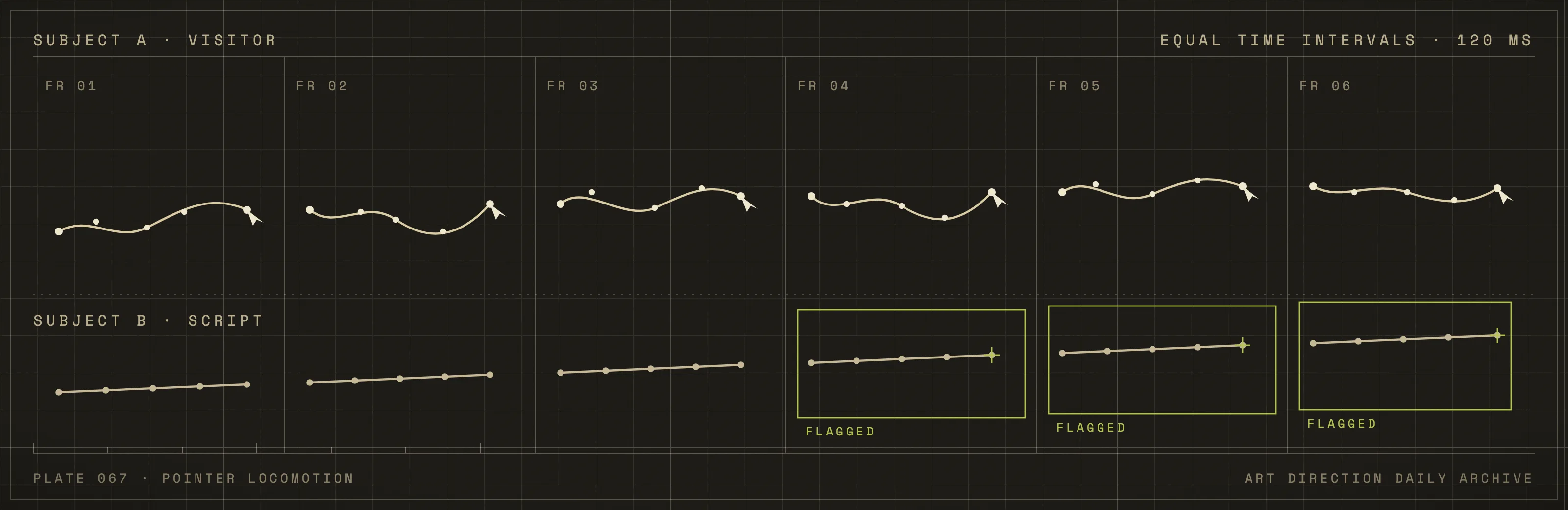
Cloudflare's Precursor reads the physics of a visit, wobble, rhythm, and pause, to sort people from scripts. The same morning, developers caught Grok Build shipping whole home directories to the cloud.
Pointer locomotion, visitor and script, six exposures at equal intervals. The even spacing gives the script away.PLATE 067
Today's Art Direction
The Motion Study
A chronophotography plate: dark emulsion, calibration grid, motion caught at equal intervals.
Before film existed, Eadweard Muybridge settled arguments about movement by photographing it against a gridded wall at equal time steps. The plates read as evidence because the grid makes every frame comparable: same scale, same interval, difference exposed. This issue borrows that apparatus for the day the web started grading motion. Stories hang as numbered plates on a dark emulsion ground, a fine calibration grid aligns everything, and the hero plate is a pointer study where even spacing exposes the script.
Cloudflare's new detection engine stops asking a checkpoint question and starts reading the entire visit: cursor physics, typing rhythm, and focus changes, scored continuously against the way people actually move. Ruler-straight paths and mathematically even timing now read as automation, which makes the ordinary wobble of a human hand a credential.
It injects its own script into pages behind Cloudflare, captures timing rather than keystrokes, and is free during the beta. If your clients sit behind the orange cloud, their visitors are already being studied in motion.
A registry for Claude Code status lines: browse community designs, install one with a single prompt, sell your own. The pitch is visibility, context use, cost, and git state at the bottom of the terminal, and the site's own advice holds for the whole genre: read the script before you install it.
Clawk v0.2.0 gives a coding agent a disposable Linux VM instead of your laptop: the repo mounts in, outbound traffic passes an allow list, and git signing stays on the host. Full autonomy inside, walls instead of promises outside.
A developer watched xAI's Grok Build package the directory it ran from, SSH keys and env files included, and upload it to Google Cloud Storage on invocation. Not the model going rogue; the harness does this by design, on every run. The Hacker News thread lands on one technique worth adopting today: treat any coding harness as untrusted code, run it from a directory that holds only what it needs, and read its traffic before trusting it near a client project.
After three months of Claude Code on her open source projects, the University of Washington professor reports modest gains, fragmented attention, and a design process she had to defend from her own tools. Her stance for working developers is harm reduction rather than abstinence or enthusiasm, and it is the sharpest critical read in a week of launch posts.
Borrow this pattern
The sequence strip
Tell one change as fixed-size frames on one visible grid: same crop, same scale, equal intervals, one caption rail underneath. The shared grid does the aligning and the comparing for you, so the difference between frames becomes the story and needs no prose to explain itself.
Use it for product state changes, onboarding steps, or before and after work. What keeps it honest: every frame is a real state, captured the same way, never a decorative duplicate padded in to fill the row.
PLATE 04
Prompt Lab
Recreate today's visual system with an AI design tool. Paste, then swap in your own subject.
Create a museum exhibition microsite styled as a 19th century chronophotography motion study. Ground: a very dark umber emulsion (#1B1914) covered by a two-scale calibration grid, faint hairlines every 38px and slightly stronger ones every 228px, drawn in translucent cream. Masthead: an exhibition wall label, a single bordered strip of four mono-caps fields (exhibit number, opening date, running time, gallery name). Hero: a huge poster-black grotesque headline in caps, a short two-line serif deck, then the signature piece: a mounted plate, a bordered panel holding a wide dark figure divided into six frames by thin vertical rules, showing the same subject advancing frame by frame with small dots marking equal time samples, plus a caption rail with a plate number. Sections run as numbered plates: a strip header with PLATE 01 in mono, a caps grotesque title, and a ruled tick band filling the rest of the line; entries sit inside a shared bordered grid as frames, each opened by a tiny mono frame counter, then a linked serif headline and two plain sentences. One accent panel uses a chartreuse border for the reusable pattern note. Palette: dark umber #1B1914, warm cream #EFE6CE, sepia #C4B896, chartreuse accent #B5C24E used only for kickers, flags, and the copy button. Type: Archivo Black for display caps, Source Serif 4 for body, Space Mono for labels and counters. Keep body text at 19px or larger with line height at least 1.65 and 60 to 75 characters per line, check small mono labels for WCAG AA contrast against the dark ground, use square corners throughout, no pill shapes, no accent left-border stripes, no gradients, no glow, no neon on black beyond the single chartreuse accent, real hover and focus states near 150ms with a reduced-motion guard, and no readable words inside any generated imagery.
Works in Beaver Builder AI, v0, Lovable, Figma Make, and Claude.
Field Note
The web spent twenty years asking whether you are human once, at the door. Now both sides examine each other continuously, frame by frame, and the evidence is motion.