Open role 080 · placement ready

What happens when the worker can delegate?

Termic's new CLI hands coding agents a task desk of their own: create worktrees, dispatch more agents, wait for results, and bring the work back.

No. 080Sunday · July 26≈ 5 min
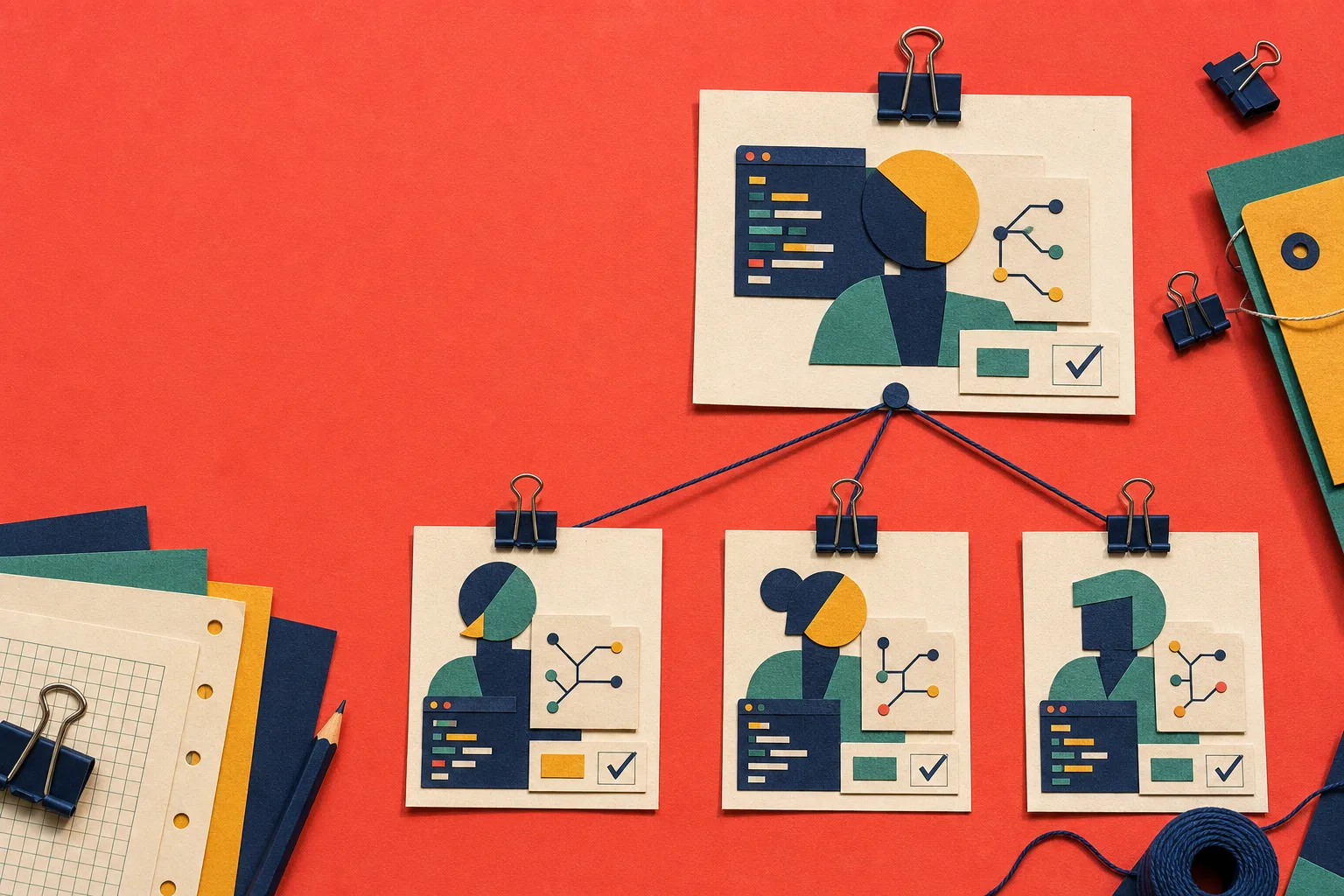
Cut-paper staffing board connecting one manager profile to three specialist profiles
Roster 04 / worktree divisionOne brief, four desks
01Tooling
Lead placement

Termic 0.24 · July 24

The worker got a staffing desk

Termic 0.24 adds an experimental command line for creating, listing, watching, opening, waiting on, and archiving tasks in the desktop app. It is designed to be scripted: JSON and streaming JSON report state, heartbeats separate a busy agent from a stuck one, and exit codes are pinned.

The consequential detail is who can use it. Every task receives the command path and its own identifier. An agent can open more tasks, wait for them, and read what they produced. The release notes call out the new operating pattern plainly: one agent can farm a job to several agents in parallel.

The unit of work is no longer one conversation. It is a roster.

For interface designers, that changes the supervision problem. A chat transcript cannot carry the full state of a team. The product now needs clear role names, worktree locations, start and finish signals, and a place where parallel results return for comparison. Delegation makes information architecture visible.

BriefOne bounded task
PlacementIsolated worktree
ReturnStructured result
02Technique
Skills match

AICreate Agent · July 22

Let the interface show why this tool was picked

AICreate's new agent sits above a catalog of 80 tools. On-device AI chooses the relevant local or connected Picsart tool, then runs it after approval. The update also adds a one-click arrangement for its Flow canvas and batch processing across local models.

A tool router is useful only when its choice remains inspectable. The agent can make the first match, but the surface should still name the selected capability, show the payload that will run, and give the reader a meaningful approval point. Think candidate recommendation, not invisible reassignment.

03Workflow
Role readiness

Agent-ready websites · July 13

A clearer site gets the agent hired faster

A new framework for agent-ready ecommerce sites separates readiness into machine readability, actionability, and decision reliability. Across 300 runs, the structured version reached 89.3 percent strict task success against 49.3 percent for the baseline. Average steps fell from 9.31 to 6.49.

That is a design result, not merely a model result. Semantic structure, explicit actions, and dependable product information reduce the amount of inference a browser agent has to perform. The best agent interface can still be an excellent human interface: fewer ambiguous labels, clearer state, and a path that does not require guessing.

Borrow this pattern

Keep the roster visible while the assignment changes

Use a narrow master rail for roles, owners, or workstreams beside a wider detail column for the active assignment. Let the rail collapse above the content on mobile. The pattern works for staffing, project intake, support queues, and multi-agent supervision because readers retain the team map while they inspect one job. Keep it honest with real labels and state; do not decorate it with fake filters or status dots.

Prompt Lab

Build the placement desk

Try it in Codex or Claude Code, or bring the same brief to Beaver Builder AI and another site-building agent.

Build a one-page landing site for a technical staffing agency called The Staffing Desk. Treat the service as matching specialist teams to one complex assignment. Use an expressive agency-poster treatment over a real landing-page structure: an above-fold open-role statement on the left and a contained recruitment-roster image on the right; a narrow candidate rail beside a wide assignment column; section markers styled as numbered role codes; assignment briefs, skills-match rows, an availability block, and a placement receipt.

Use saturated coral #E95C43 as the outer wall color, inky navy #17263A for rules and type, warm paper #F6EDDA for reading surfaces, sea green #277F70 for confirmed states, and mustard #F0BE3F for one strong secondary field. Pair Archivo Black display type with Source Sans 3 body, Fraunces italic for one editorial pull line, and IBM Plex Mono for role labels. Build one tactile cut-paper roster tableau with blank label bars and abstract profile geometry; never put fake readable text inside the image.

Keep body copy at 19px with at least 1.65 line height and a 60–75 character measure. Use square paper dossiers, hard rules, slight physical offsets, and only one deliberate shadow. Make real links respond on hover and focus, and respect reduced motion. No neon, gradients, glowing UI, pill collections, generic three-card feature rows, fake search, fake toggles, accent side stripes, or stretched empty panels. Maintain WCAG AA contrast at both desktop and 390px mobile widths.

Field Note · quality lead

A bigger rulebook can be a calmer default

Ruff 0.16 expands its default lint set from 59 rules to 413. The project now carries 968 rules in total, compared with 708 when defaults last changed. The release also formats code blocks inside Markdown, shows available fixes in check output, and lets teams record reasons beside ignored rules.

The useful move is not “turn everything on.” It is placing more dependable judgment in the shared baseline, then making exceptions legible. A team of agents needs the same thing a team of people needs: a house standard that catches ordinary mistakes without turning every assignment into a policy meeting.

PlacedShared defaults before bespoke instructions
ProofMachine-readable state, explicit approvals, recorded exceptions
Design consequenceBuild for the roster, not only the chat

Verified placement files

Sources

  1. Termic changelog: v0.24.0 release notesTermic · July 24, 2026
  2. What's New: AICreate AgentAICreate · July 22, 2026
  3. Designing Agent-Ready Websites for AI Web AgentsarXiv · July 13, 2026
  4. Ruff v0.16.0Astral · July 23, 2026