Who is your dev environment actually for?
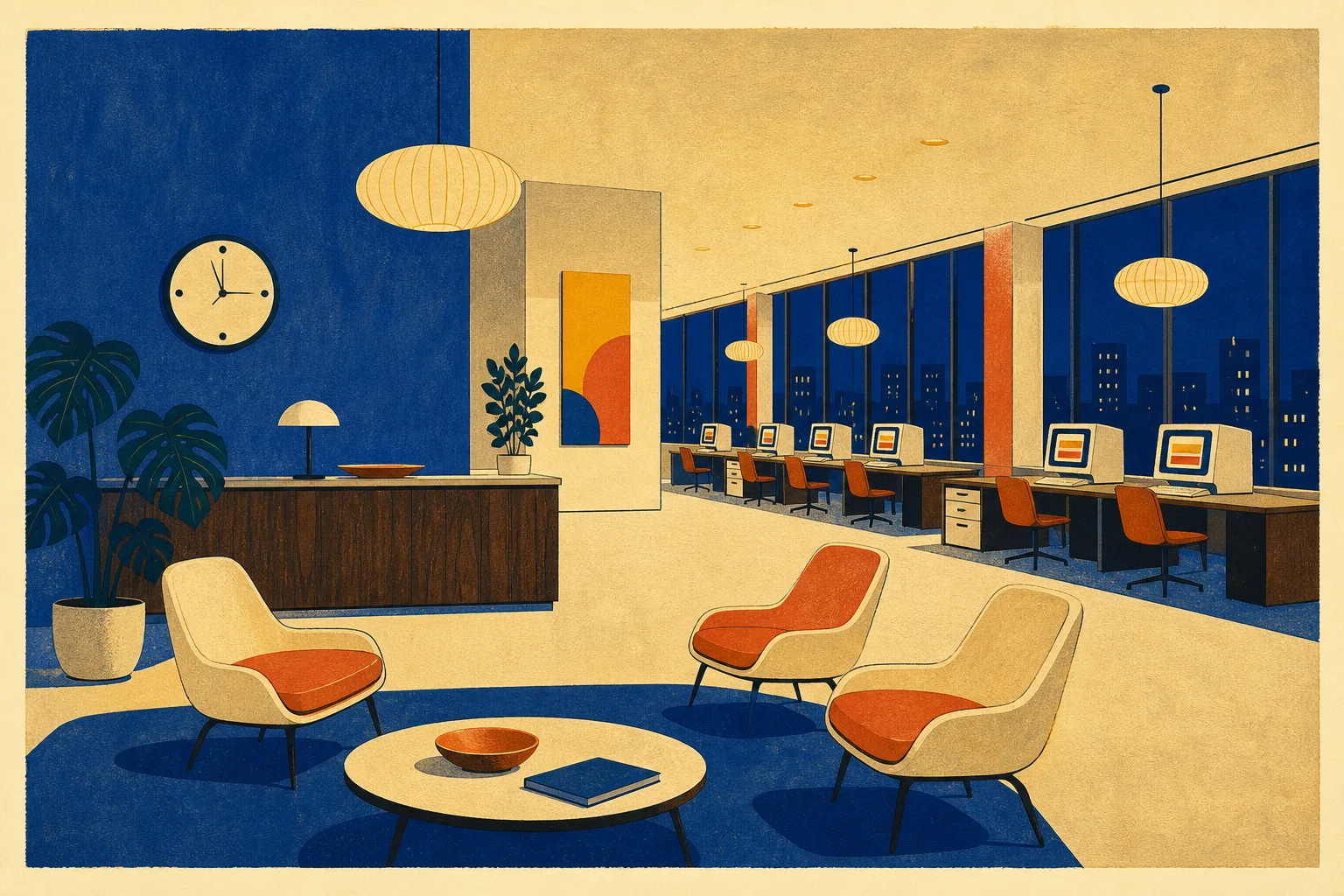
Cloud agents now write more than half of Cursor's merged pull requests, so the company rebuilt its development environment as a product for them. Today's issue is the leasing page for that kind of workspace: a mid-century coworking brochure, toured room by room.
The Leasing Office
Today's Art DirectionThe Night Office: a mid-century coworking brochure, toured room by room while the lights stay on and the chairs stay empty.
Mid-century modern is the house style of the postwar office: geometric Futura-style capitals, warm cream against saturated cobalt, furniture drawn in flat gouache. This issue borrows the leasing brochure of that era and hands the space to a workforce that never sits down. The keyed floor plan does the structural work: every numbered room on the plan is a section of the page, and every section wears its key like a door number.
The Workshop
ToolingCursor: how we set up our cloud agent environment
Cloud agents now author more than half of Cursor's merged pull requests, up from roughly one in ten in December. The post reads like facilities management: Ubuntu VMs built from one shared Dockerfile, an in-house CLI that wraps every build command, and a Cloud Doctor that reads agent traces and opens pull requests against the environment itself. The line that names the whole shift: the development environment is a product in its own right, only one whose users are agents.
Sign in with ChatGPT arrives on Vercel
A ChatGPT account now works as a login for Vercel and v0, from the Vercel plugin inside ChatGPT or from the regular sign-in page. Two-factor and single sign-on requirements still apply.
Launch HN: Prized wants non-engineers building internal tools
A YC Summer 2026 launch pitching secure internal tools built by the staff who need them, with guardrails standing in for engineering review. The founders take the hard questions in the thread.
The Library
TechniqueJim Nielsen catalogs the AI aesthetic
The visual tells of the moment, collected: the sparkle glyph, streaming and shimmering text, hairline icons, cream grounds with orange accents and serif type. Nielsen asks which of these will settle into software convention for decades and which will date a design to 2026.
Refactoring, priced in tokens
On martinfowler.com, Thoughtworks CTO Giles Edwards-Alexander reruns the case for refactoring with tokens as the unit of account: restructuring a 17,155 line data access layer cut the input tokens needed for later changes by 83 percent. Clean architecture now has a line item.
The Front Desk
WorkflowFigma put agents on the security rotation
Figma's security team built an agent system that triages and investigates alerts, and time to resolution on complex cases fell 71 percent. The writeup is candid about what made it work: three kinds of memory, scoped tools per intent, and deterministic post-steps where prompts used to be the safety net.
The Corner Office
Design MoveThe keyed floor plan. Draw one honest diagram of the thing the page sells, number its parts, and let those numbers become the page's section markers. Every key on the diagram anchor-links to a section, and every section repeats its key, so the reader always knows where they are in the building.
It fits any client whose offer has real geography: a venue, a clinic, a restaurant floor, an office lease, a conference hall. What keeps it honest: the diagram reflects actual structure rather than decoration, each key resolves to exactly one section, and the plan degrades to a plain list of links on small screens.

The Print Room
Prompt LabPaste this into an AI page builder to reproduce today's visual system.
Build a one-page membership landing page for a coworking space, art directed
as a mid-century modern brochure. The twist: the space is marketed to teams
whose newest workers are software agents, so the office is shown running at
night with no one in the chairs.

Canvas and palette: saturated cobalt blue page ground (#26429B), warm cream
content panels (#F5EEDB), dark navy ink text (#1C2340), persimmon orange
accents (#D95B2B), mustard yellow secondary accents (#DFA23C). No gradients,
no glow, no purple.

Structure, top to bottom: a cream top bar with the wordmark left and two nav
links right. A cobalt hero with a small cream door plaque (three stacked
monospace lines: number, date, reading time), a large uppercase geometric
display headline, a two-sentence serif deck, and a wide framed illustration
in a cream mat. Then the signature module: a keyed floor plan drawn as an
inline SVG on a cream panel. Eight rooms inside one heavy outline, each room
holding a small persimmon key square with a number and an uppercase room
name; every room anchor-links to a page section, with a monospace legend of
the same links underneath for small screens. Each following section is a
cream panel headed by its persimmon key number, an uppercase room name, and
a small monospace tag on the right. Close with a dark ink colophon panel.

Type: a Futura-style geometric sans (Jost) in caps for display, labels, and
room names; a warm text serif (Lora) at 19px or larger with 1.7 line height
for body; a monospace (IBM Plex Mono) for plaques, tags, and legends only.

Imagery: flat gouache illustrations of mid-century office interiors at
night, cobalt walls, cream furniture, mustard and persimmon accents, screens
showing only abstract color bars. No readable text inside images, no people.

Guardrails: body text never below 18px, line length 60 to 75 characters,
WCAG AA contrast on every label against its actual background, radii 12px or
less on panels, hover and focus states on all links at 150ms, a
prefers-reduced-motion guard, no fake UI controls, no emoji, no neon.
Works in: Beaver Builder AI, v0, Lovable, Figma Make, Claude Code.
The Courtyard
Field NoteThe sharpest design brief of the week is Cursor's: the development environment is a product whose users are agents. Designing for the occupant you actually have, rather than the one you pictured, has always been the whole job.
Building Directory
Sources- How we set up our cloud agent environmentcursor.com
- The AI Aestheticblog.jim-nielsen.com
- How we secure Figma's internal systems with agentsfigma.com
- The Economic Benefit of Refactoringmartinfowler.com
- Sign in with ChatGPT is now available on Vercelvercel.com
- Launch HN: Prized (YC S26)news.ycombinator.com