An operating system where every app starts as a prompt
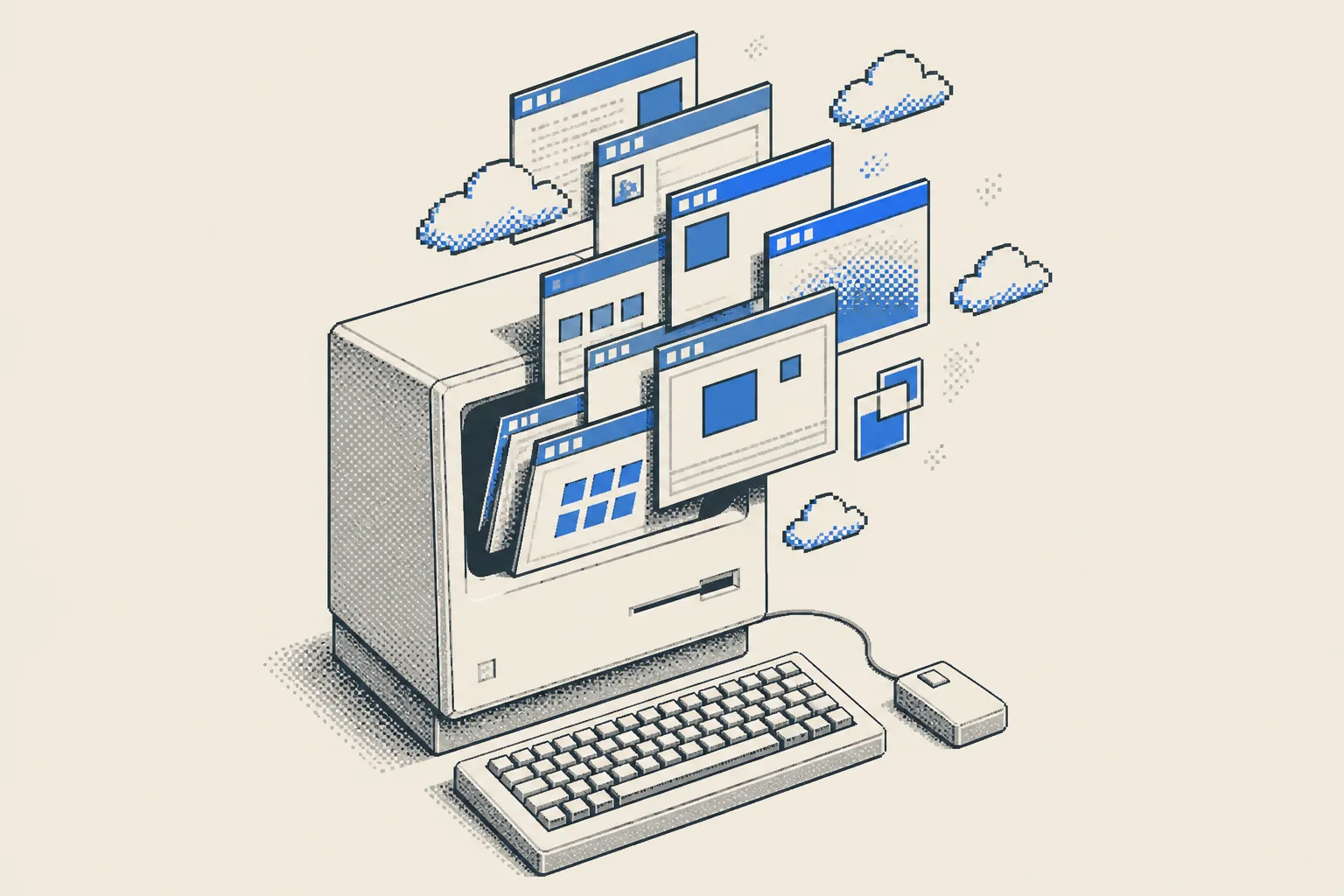
Cloudflare OS is an open platform where anyone in the company directs agents, permissions arrive one resource at a time, and full-stack internal apps ship from a prompt. The desktop metaphor is suddenly load-bearing again.
System 90
Platinum windows on a midnight desktop; the launch page as operating system.
Today's page borrows the interface grammar of a mid-nineties operating system: a fixed menu bar, platinum windows with pinstriped title bars, desktop icons that actually navigate, and a dithered wallpaper holding the desk together. Poolsuite proved the register can sell a product; here every section is a window, so the label becomes chrome and the cascade becomes hierarchy. It suits a day when the lead story is literally an operating system for work.
Google reshuffles its AI brain trust
Demis Hassabis is stepping down as Google DeepMind CEO to become its chairman and Alphabet's first chief scientist, with CTO Koray Kavukcuoglu now running the unit and reporting to Sundar Pichai. In the same wave, Jeff Dean, Sanjay Ghemawat, Oriol Vinyals, and Quoc Le are leaving to found a research startup called Discovery Loop.
An operating system for the org chart
Cloudflare released Cloudflare OS, an open-source platform that gives everyone in a company a browser-based agent workspace grounded in shared context, skills, and data. Agents research, draft documents, run deterministic workflows, and generate full-stack apps that deploy as Workers with their own SQLite databases, shareable as live instances or as blueprints a colleague can remix.
The security model is the part worth studying if you design agentic products. Agents start with zero access; permissions are granted per resource through service-specific gatekeeper Workers that never expose credentials; and policy follows data through everything an agent produces, so a shared dashboard cannot leak what its author was never allowed to see.
GET INFO: CLOUDFLARE OS
- Workspaces
- Browser-based, persistent state, isolated runtime for code. No terminal required.
- Gatekeepers
- Zero access by default; per-resource grants; credentials never reach the agent.
- App platform
- Generated client and server ship as Dynamic Workers with SQLite databases.
- Model routing
- All inference through AI Gateway, with per-user and per-team budgets.
Ten-pixel type from an image model
Alibaba's Qwen-Image-3.0-Pro renders legible text down to 10px across 12 languages and more than 20 fonts, and lays out whole newspapers, menus, and web pages in a single pass. At $0.003 to $0.075 per image it is priced like a comp machine for working designers, and the model card leans into that framing over gallery art.
Team standards, one install
Vercel's skills.sh now bundles agent skills into shareable skill packs: collect the skills a team relies on, share one URL, and a single command installs the whole set. Pin a pack to a GitHub organization and every project starts its agents from the same playbook, a distribution shape design systems are starting to borrow.
Analyze, do not create
The Rust project adopted an LLM policy for its main repository: models may answer, review, distill, and check, but the contribution itself must be written by a person, and any LLM involvement must be disclosed. One of the largest codebases in open source just drew its line at generation while keeping analysis, a split worth watching for any team writing its own rules.
Title-bar sectioning
Swap anonymous cards for titled windows. Each section gets a container whose chrome names it: a thin title bar carrying the section label, a bordered content pane below, and a small horizontal offset so the stack reads as a cascade instead of a grid. The label stops floating above the box and becomes part of it, which buys hierarchy without another font size.
What keeps it honest: title bars carry real section names, decorative widgets stay aria-hidden, and every element that reads as clickable really is. Reach for it on launch pages for developer tools, personal sites, or any product that is itself software.
Rebuild today's desktop in the agentic builder you use. Copy the prompt below and trade the platform for whatever you are launching.
Build a one-page product launch site for a developer platform, styled as a
retro operating-system desktop. Page archetype: SaaS launch landing page
whose sections are desktop windows.

Ground: a full-bleed dark dithered wallpaper (deep graphite blue, #262B33)
with a coarse pixel-cloud texture; never set text directly on it. A fixed
menu bar runs across the top: platinum strip, 2px ink rule below, brand at
left in a pixel display face, real nav links as menu words, issue or version
metadata at the right end.

Every section is a platinum window (#EDE9DE) with a 2px ink border (#17181C),
a hard 6px offset shadow, and a title bar of thin horizontal pinstripes with
the section name centered in the pixel face on a platinum patch. Decorative
close and zoom boxes are aria-hidden. Stagger window widths and left/right
offsets down the page so the stack reads as a cascade, not a card list.

Add a row of desktop icons on the wallpaper near the top: small pixel-art
SVG glyphs on platinum tiles with mono labels, each a real anchor link to a
section. On hover, the label inverts to selection blue (#2E5BE0) like a
selected file.

Type: a pixel display face (Pixelify Sans) for the headline, window titles,
and menu bar; a plain humanist sans (Instrument Sans) at 19px with 1.7 line
height for all body text; a mono (Space Mono) for labels and metadata.
Selection blue (#2E5BE0) is the only loud accent: links, buttons, hovers.

Hero: the largest window, holding a two-line pixel headline, a two-sentence
deck, one bordered platinum button with a double keyline (the default-button
ring), and a dithered bitmap illustration in the manner of an old system
welcome splash.

Guardrails: body at least 18px at 1.6 line height or more; ink on platinum
for all small text; text never sits on the wallpaper outside a window or a
solid label; no neon, gradients, or glow; corner radius 0 to 8px; real hover
and focus states around 150ms with a prefers-reduced-motion guard; no fake
toggles, search fields, or dead widgets; no legible text inside generated
images.
Works in Figma Make, Bolt, Beaver Builder AI, v0, or Lovable.
The desktop metaphor has outlived every obituary written for it. When the pitch is that anyone in the company can make software, the friendliest picture anyone has found is still a window you can move.
- Cloudflare OS: an open platform for agents, apps, and work (Cloudflare)
- Google DeepMind CEO Demis Hassabis is stepping down (Axios)
- Demis Hassabis drops DeepMind CEO role to become Chair and focus on AGI (9to5Google)
- Qwen-Image-3.0-Pro model page (Qwen Cloud)
- Skill packs are now available on skills.sh (Vercel changelog)
- rust-lang/rust is adopting an LLM policy (Rust blog)
Issue No. 090, Wednesday, August 5, 2026. Set in Pixelify Sans, Instrument Sans, and Space Mono. Palette: midnight wallpaper, platinum windows, ink chrome, selection blue, one manila sticky. Made in Claude Code on Fable 5; images by gpt-image-2. Follow @artdirdaily on X.
A field experiment from the team behind Beaver Builder AI.