NO. 110 · Thursday, August 27, 2026 Reading time ≈ 4 min · Three rooms
A retrospective in three rooms
Nvidia is buying the shelf where open models live
The Information reports Nvidia has agreed to pay $12.9 billion for Hugging Face, the commons where the web's open models are shared and downloaded. The deal is not signed, and it would change who owns the shelf.
A museum exhibition page hung in Yayoi Kusama's dots.
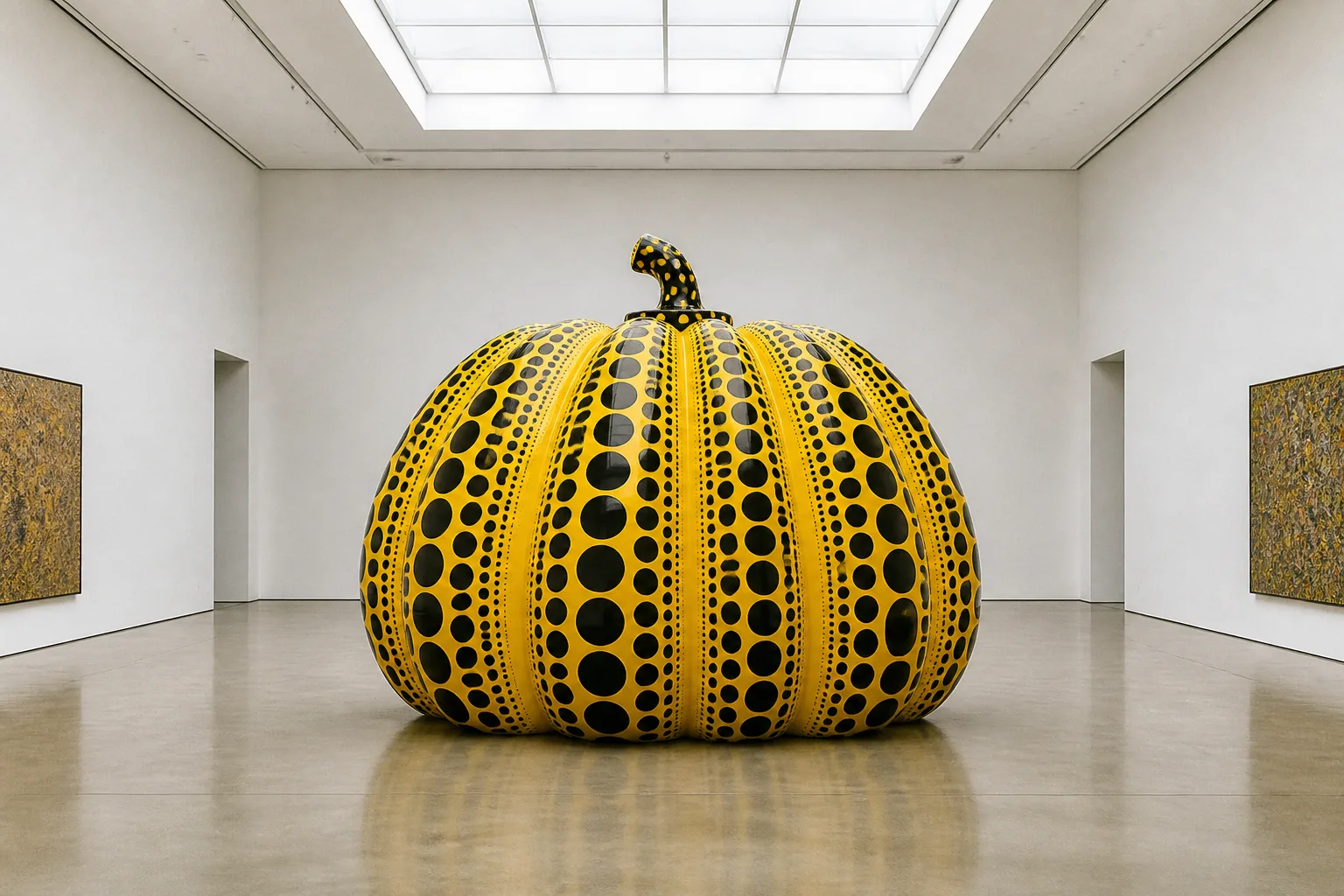
Today's issue is built as the landing page for a retrospective exhibition, the kind a museum or gallery commissions for every major show. The walls are warm gallery white, the headline is set like vinyl wall text, and every image hangs with a proper wall label. The day's news items are the works on view, grouped into three numbered rooms. The dots, the pumpkin, and the mirrored infinity belong to Kusama, whose death was announced this week; the Field Note explains.
wall text
wall label
room numbers
installation view
polka dot
catalogue page
gallery white
Room 1
Tooling
Nvidia reportedly agrees to buy Hugging Face for $12.9 billion
The Information reports an agreement, though TechCrunch notes nothing is signed and the talks could still fall apart. Hugging Face is where most AI build tools source their open models, so the price of admission to the open model commons would now be set by the company selling the chips underneath it.
For working designers the question is practical: the model behind your favorite background remover, upscaler, or layout critic probably lives on that shelf. Worth watching what happens to hosting, licensing, and the free tier once the papers are signed.
Concord lets Claude Code, Codex, and Cursor work the same repo
Concord is an open-source MCP server that gives coding agents from different vendors a shared work state: presence, file claims, direct messages, and explicit handoffs, all in a local SQLite file. If you run more than one harness on a client project, this is the first serious attempt at keeping them from colliding.
Room 2
Technique
Web widgets that float outside the browser window
Daniel Schwarz walks through the Document Picture-in-Picture API on CSS-Tricks: any HTML, CSS, and JavaScript in an always-on-top floating window, where the older picture-in-picture API handled only video. Chrome and Firefox support it on desktop; Safari does not.
Issue 108 argued the chat widget deserved better than a launcher bubble. This is the API that lets it leave the page entirely, and the styling catch is real: cloned components lose their CSS context, so the article leans on non-specific selectors and a picture-in-picture display-mode media query.
02Infinity, mirroredInstallation view, Room 2. Lanterns, mirror, still water.
Room 3
Workflow
SourceHut bans LLM-written content from September 10
The code host updated its terms of service to prohibit content written with LLMs across code, tickets, and communications, enforced on the honor system with no retroactive sweep. One host drawing a hard line is a useful marker of how far apart the industry's norms have drifted.
The asteroid currently hitting frontend web development
Nolan Lawson's widely shared essay argues the craft is being reshaped mid-flight: the tools now write most of the code, and the job is drifting toward review, taste, and system stewardship. A sober read from a respected frontend voice, not a doom post.
Borrow this pattern
Caption like a gallery
The reusable move in today's issue is the wall label: a three-part caption component with an index number, a short title in a heavier weight, and one quiet line of metadata underneath. Museums use it because it carries a lot of information without competing with the work.
Swap it in wherever you are captioning images or cards: portfolio pieces, product photography, case study screenshots, team headshots. Restraint carries it. The number is small and colored, the title is one line, the metadata is real (medium, date, client, location), and the label never grows a border, icon, or button it does not need.
Prompt Lab
Exhibition catalogue
Paste this into an AI build tool to hang your own retrospective. It reproduces today's page system: the exhibition archetype, the wall labels, the numbered dot nameplate, and the guardrails that keep it readable.
Build a one-page museum exhibition landing page for a retrospective.

Archetype: an exhibition microsite a gallery would commission. Structure,
top to bottom: a thin top nav; a nameplate row with a large solid red
circle holding the exhibition number in a condensed display face, next to
two small monospace lines of date and visiting details; a two-column hero
with a huge uppercase condensed headline set like vinyl wall text on the
left and one framed artwork image on the right; a bordered curator's
statement panel; three content sections labeled ROOM 1, ROOM 2, ROOM 3,
each opened by a small red dot, a big room number, and a hairline rule;
one full-width image band between rooms; a dark inverted "borrow this
pattern" panel; and a visitor-information footer in small monospace type.

Wall labels: every image gets a caption block with a small red index
number, a one-line bold title, and one monospace metadata line (medium,
room, materials). No other caption styles anywhere.

Palette: warm gallery white #F5F2EA ground, ink #211D18 text, vermilion
red #C2201F reserved for dots, index numbers, and link underlines, one
pumpkin yellow #E0A310 note inside the dark panel. No gradients, no
glows, no neon.

Type: Anton for the headline and room numbers, uppercase, tight leading.
Newsreader for all body text at 19px with 1.7 line height, 60 to 75
characters per line. IBM Plex Mono only for labels and metadata.

Guardrails: body text never sits on an image; images are photographs of
physical artwork in real gallery light, never fake screenshots with
readable text; borders are 1px ink, corners square; hover states on
links only, 150ms; respect prefers-reduced-motion; meet WCAG AA
contrast for every label on its actual background.
Beaver Builder AI hangs it straight on the wall; Lovable, v0, and Figma Make install it too.
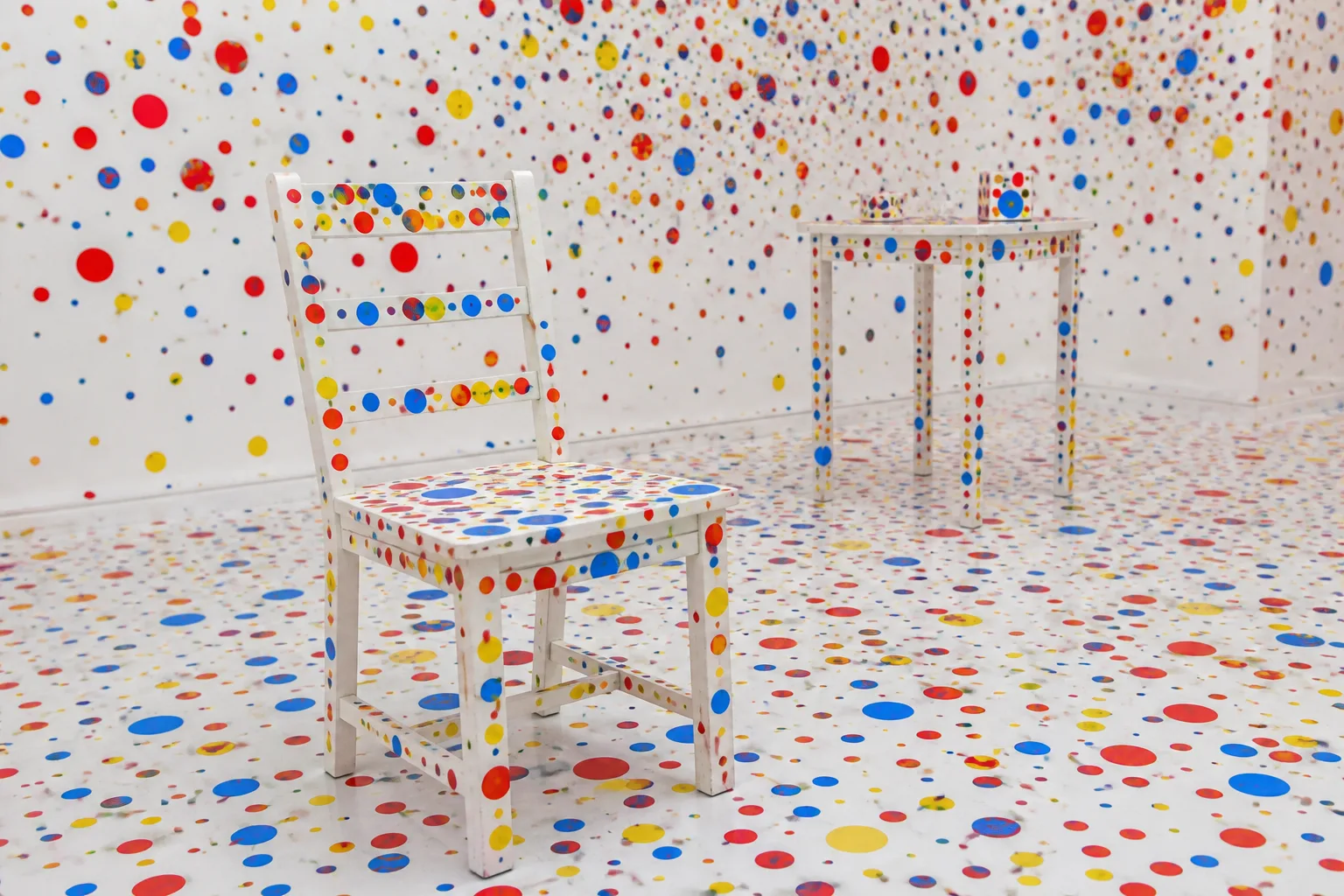
03Obliteration, participatoryInstallation view, Room 3. Adhesive dots on white furniture.
Field Note
Yayoi Kusama died on August 14 at 97; the news reached the design world this week. She spent seventy years proving that one obsessive mark, repeated with total conviction, becomes a universe. Today's walls are hers.