htmx's CEO is banning AI from the shop every Friday
The CEO of htmx is mandating one AI-free workday a week and inviting every other shop to sign on. The same morning, an essay made the sharper claim: your taste only survives on the days you use it.
Shop schedule · effective immediately
The motion on the floor is No AI Fridays, a one-page site that hit the Hacker News front page today. The pitch: turn the assistants off one day a week, write code with your own hands, read the documentation, and think things through yourself. The author, writing as the CEO of htmx, has already mandated it at the shop and will list any company that joins.
The site stakes its case on cognitive debt, weakened critical thinking, and hampered skill formation, then lands the line that matters for this audience: constant delegation means you stop noticing the choices the model makes for you, including the aesthetic ones. Coming two days after htmx 4 shipped, it reads less like nostalgia and more like a maintenance schedule for judgment.
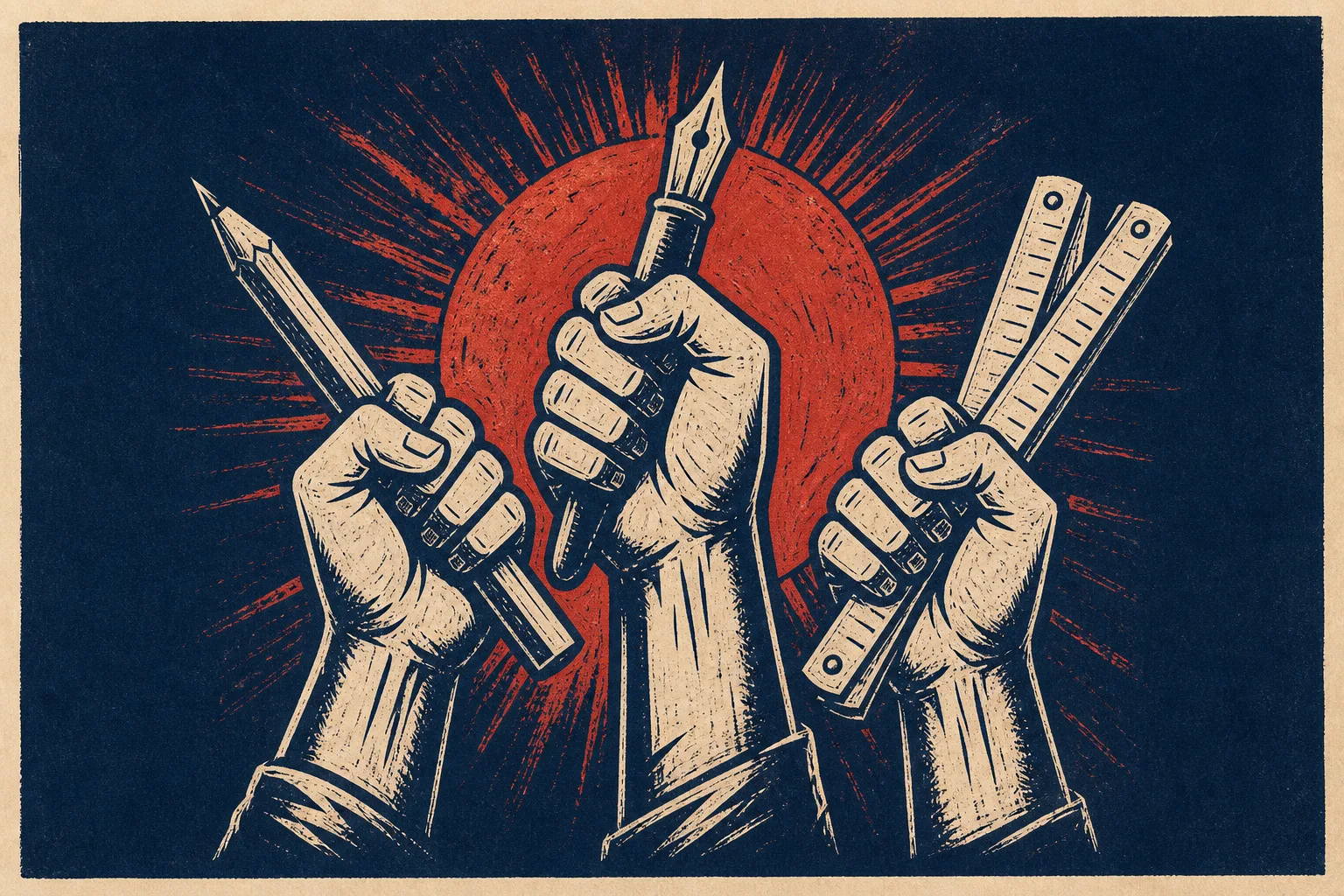
The Union Hall
A labor-broadside pledge page: indigo and vermillion ink on washed chambray.
Today's page is a campaign landing page dressed as a printed union broadside: the kind of nonprofit or advocacy one-pager a freelancer builds for a cause that needs signatures. A woodtype Clarendon slab does the shouting, a plainspoken Franklin gothic carries the floor debate, and typewritten Courier holds the minutes. Sections run as numbered resolutions on a meeting docket, the imagery is linocut placards pinned to the wall, and the whole thing sits on a washed chambray ground with a doubled selvage rule at the left edge, like fabric still on the bolt.
- Woodtype slogan
- Union roundel
- Docket rows
- Exception cell
- Pledge card
- Linocut placard
- Selvage rule
Tooling · read into the record
Adopted Aug 30Murmell puts every coding agent on one shared canvas
A Show HN today: a browser canvas where Claude Code, Codex, and friends work the same project side by side, with live terminals and cursors visible to the whole team. File reservations are enforced at the machine level, so two agents cannot grab the same file no matter how politely they were prompted.
Lovable will now run ten hours on a single message
The counterpoint to the day's theme, straight from Lovable's changelog this week: one prompt can now sustain up to ten hours of autonomous work, with real-time cost tracking added so you can watch the meter run. The same batch of updates previews how each app page will look in search results and link cards.

Technique · the taste question
Adopted Aug 30But where does taste come from?
Christine Lemmer-Webber, published this morning and the best companion piece the pledge could ask for. Her argument: taste is built by hands-on practice and eroded by marinating in generated output, which pulls your own cadence toward the average. The prescription is the same as the poster above: make things yourself, and seek out weird art on purpose.
Has vibecoding fried your brain? Take the quiz
A lighthearted diagnostic from learning platform Codeset: pick one of five languages and take a timed test with no model in the loop, then get graded on a scale that runs from intact to fried. A joke with a real use, since it is the rare tool that measures what you can still do alone.
Workflow · old business
Adopted Aug 29Bug blindness gets worse when nobody is looking
Dan Luu on why teams stop seeing their own defects: everyone routes around the same broken flows until the workaround becomes invisible, and internal confidence stays high while quality falls. He notes the stakes have risen with coding agents, which make it easier to produce a lot of software nobody has actually looked at.
Borrow this pattern
The exception cell
Build a strip of identical cells, then let exactly one break the pattern by hand: the week row above is seven equal boxes, and the entire policy lives in the single struck-out Friday. The move works anywhere a schedule or tier meets one loud exception: the closed day on a restaurant hours card, the sold-out date in a booking rail, the plan a pricing table wants you to notice.
What keeps it honest: the strip must be real information, not decoration; the exception gets one treatment (a strike, a fill, a stamp), never three at once; and the marked cell still states its meaning in text, so the message survives without the color.
Signed ______________________
Prompt Lab · Minutes of the meeting
Copy and pasteRecreate today's union broadside as a working campaign page. Paste the minutes below into your build tool of choice.
Build a one-page campaign landing page for a pledge drive, styled as a
printed union-hall broadside.

Layout: a top nav, then a masthead with a circular two-ring union stamp
(SVG text on a path around the rim, a red number in the center) beside a
three-line typewritten docket (number, date, reading time). Hero: an
all-caps woodtype slab headline at clamp(2.7rem, 7vw, 5rem) with one word
in red, a two-sentence deck, then a seven-cell week strip in a bordered
grid where exactly one cell is struck through with a hand-drawn red X and
a small label naming the exception. Below, a two-column row: lead copy
left, a framed poster image right with a hard 6px offset shadow.

Sections are numbered resolutions: a top border, "Res. 2" in the display
face in red, an uppercase letterspaced title, an adopted-date stamp
pushed right. Items are bold headlines with one or two plain sentences.
Add one cream pledge card with a label, a short vow, and a signature
rule; and a minutes panel holding this prompt in typewriter monospace.

Type: Bevan for display, Libre Franklin for body at 19px with 1.7 line
height, Courier Prime for all stamps, docket lines, and minutes. Palette:
washed chambray ground #CDD5E1, indigo ink #1F2A44, vermillion accent
#C63A22, unbleached cream #F2EAD8 for the pledge card, slate muted
#5C6A85. Add a faint print-grain noise texture and a doubled vertical
rule fixed at the left edge of the viewport, like selvage on fabric.

Guardrails: body text at least 18px, never justified; small labels meet
WCAG AA on their actual background; borders 2px solid ink, corners
square; no gradients, no glow, no pill shapes, no fake form fields; the
struck cell also states its meaning in text; hover states on links at
about 150ms; include a prefers-reduced-motion guard.
Works in Bolt, v0, Lovable, and Beaver Builder AI, or straight in your editor.
Field note · adjournment
Whatever you think of the pledge, the design version is worth running: spend one working day this week building a layout with no generation in the loop, and notice which decisions you have stopped making. The meeting stands adjourned.